Environmental

Environmental
Silt curtains and log booms
The isolation of construction sites from waterways is a crucial part of any project. Silt curtains provide a barrier that protects waterways from the potential of sediment run-off in the construction process.
Temporary and permanent log booms protect both temporary and permanent infrastructure in waterways that might be subject to interference or damage from heavy floating objects like logs.
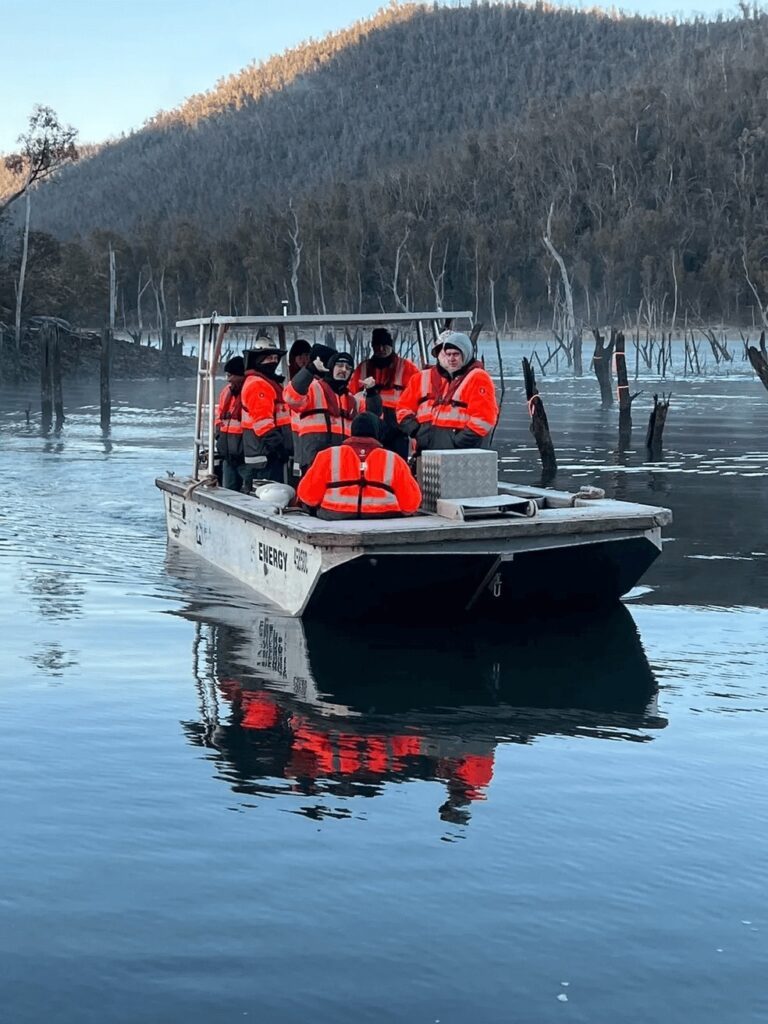
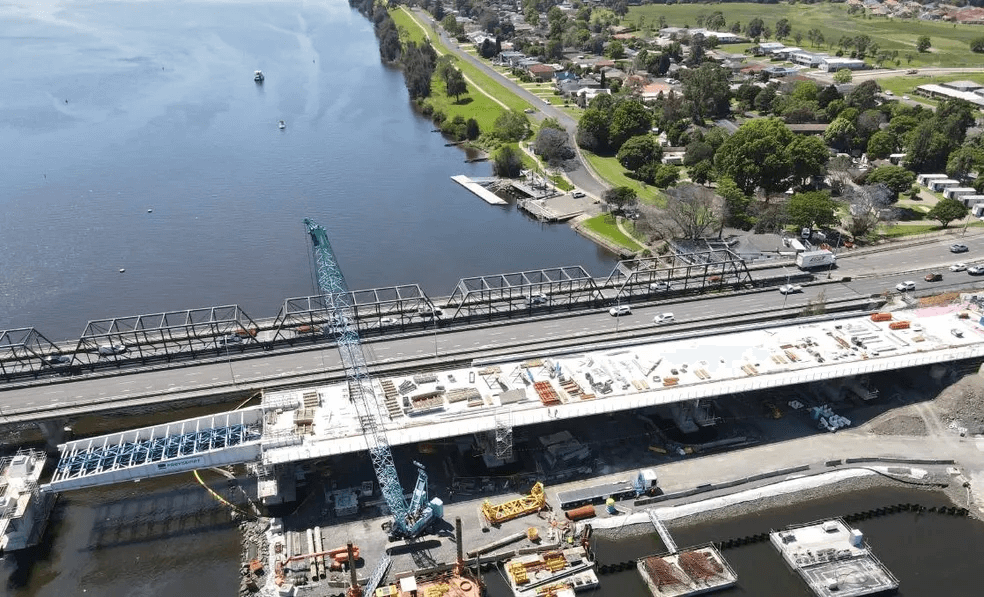
We provide full supply, installation and management of silt curtains and log booms for any project. Our team has delivered environmental containment work on some of Australia’s most demanding water sites, including Snowy Hydro 2.0, the Nowra Bridge replacement and Cotter Dam. We can supply the barrier, vessels, anchoring and crew as one package, so there’s no gap between the gear arriving and the work getting done.
What is a silt curtain and what does it do?
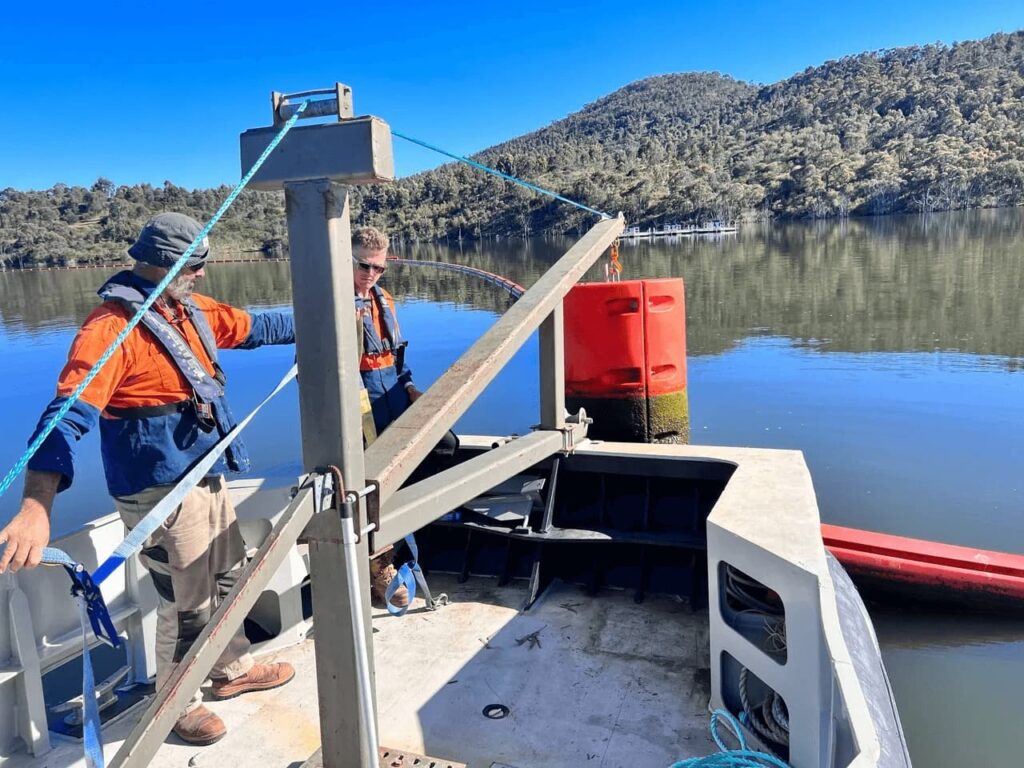
A silt curtain is a floating barrier with a weighted fabric skirt hanging beneath it, used to contain suspended sediment during in-water construction. Flotation holds the top at the surface, ballast chain keeps the skirt vertical, and anchors hold the line in position. It confines the sediment plume to the work area so turbidity stays within the limits set by the project approval.
Silt curtains are used on bridge works, wharf and jetty construction, dredging, pile driving, outfall installation, dam works and shoreline remediation. They work as a temporary sediment control, installed for the duration of the works and removed afterwards.
When does a project need a log boom?
A log boom is a floating barrier of linked pontoons or timber used to intercept and deflect heavy floating debris before it reaches a structure. Projects need one where logs, timber and vegetation travel down a waterway toward bridge piers, intake screens, pontoons, moored plant or a swimming enclosure, particularly after rainfall.
Log booms can be installed as a temporary measure for the length of a construction program, or as a permanent asset with a mooring system designed to stay in place year-round. Where floating hydrocarbons or fine surface debris are also a risk, a floating containment boom can be run on the same anchor array so the site doesn’t pay for two separate mooring campaigns.
What we supply
Our environmental marine services cover the full life of the barrier, not just the delivery:

Supply and hire of silt curtains, turbidity curtains, log booms and floating containment booms, sized to the sit
Design of the anchoring and mooring layout ,including anchor type, spacing and buoying for the depth, bed type and current at your site
Installation using crewed punts and workboats, worked around tide and weather windows
Ongoing management and inspection through the works, including sediment clearing, re-tensioning and repairs
Recovery, cleaning and removal at the end of the program
Vessel and crew support for the surrounding work, including material transport, debris removal, plant positioning and personnel movement
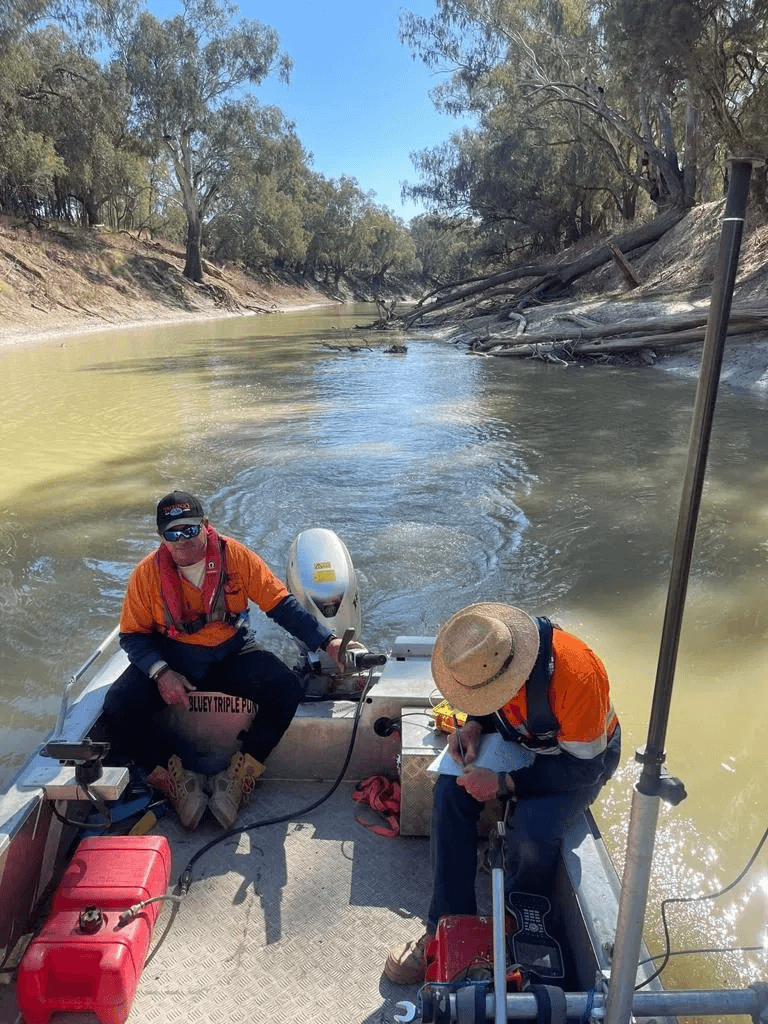
Support for turbidity monitoring and survey alongside our hydrographic survey and marine construction teams
The vessels behind the work
Environmental containment work is anchor work, and anchor work needs a deck. Our punts and workboats are the ones that do most of it:
- Shallow and smooth-water sites suit a small punt such as Little Mate, a 4.9 metre catamaran rated for smooth and partially smooth waters.
- Larger runs and heavier ground tackle go on modular barges, which give a stable non-propelled platform and can be configured to the job.
- Open and coastal sites need something like Crooked, a 9.1 metre tri-hull cleared for 2C operations.
The full range is on our fleet page, and vessels can be fitted with cranes, winches, anchoring systems and generators depending on what the containment job needs.
Compliance and standards
Every vessel we operate is maintained to commercial survey standard and complies with the National Standard for Commercial Vessels under the Australian Maritime Safety Authority (AMSA).
Our skippers hold current AMSA Certificates of Competency for the vessel and operational area they work in. Plus, our crews come from marine, construction and government backgrounds, so they work comfortably under a principal contractor’s safety management system.
On the environmental side, sediment control on Australian projects is generally assessed against IECA Best Practice Erosion and Sediment Control, along with state requirements such as the Protection of the Environment Operations Act in New South Wales. We keep inspection and maintenance records throughout the job, because controls that worked but were never documented still cost you at the compliance review.
Where we work
Boab Commercial Marine operates Australia-wide from our base at Oak Flats, New South Wales. Our fleet is road-transportable, so we mobilise to coastal and inland sites that many operators can’t reach. We regularly work across Sydney and NSW waterways, the Shoalhaven and Illawarra, the Snowy Mountains and ACT, and into Queensland, Victoria, Western Australia, South Australia, Tasmania and the Northern Territory.
Frequently asked questions (FAQs)
What is the difference between a silt curtain and a log boom?
A silt curtain controls suspended sediment in the water column using a weighted fabric skirt below the surface. A log boom deflects heavy floating debris on the surface using linked pontoons or timber. One manages water quality; the other protects structures. Many sites need both, and they can share the same anchor array.
Do silt curtains work in tidal or fast-flowing water?
Silt curtains hold reliably in currents under about half a knot. They can also be engineered to work in flows up to roughly two knots using permeable panels, tension cables and anchors set for both directions. Above two knots, the load exceeds what most mooring arrays can hold, and a different control method is needed.
How long does a silt curtain installation take?
It depends on the length of the run and the current. In still or slow water, a straightforward run can go in within a day. In tidal channels, the work is limited to slack windows of roughly 20 to 60 minutes per tide, so the same run may take two or more tides. We give a realistic window once we have assessed the site.
Do you supply the curtain, or can you install one we already have?
Both. We supply, install and manage the full system. Our team can also install and maintain client-supplied silt curtains and log booms. If the gear is already purchased, we will assess whether the specification suits the current and depth at your site before installing it.
Do you provide the vessels and crew as well?
Yes. Supply, anchoring, installation, vessels and certified skippers may come as one package, which means a single point of contact and no coordination gap between the equipment and the boats. Vessels can also be hired separately if your own crew is doing the containment work.
Who is responsible for turbidity monitoring during the works?
Monitoring obligations sit with the project’s environmental approval and are usually held by the principal contractor or their environmental consultant. We support that work by providing the vessels, crew and access needed to take readings, and by maintaining the barrier so it performs the way the approval assumes it will.
Are your vessels and skippers AMSA-compliant?
Yes. All Boab vessels are maintained to commercial survey standard under the National Standard for Commercial Vessels, and our skippers hold current AMSA Certificates of Competency appropriate to the vessel and its operational area. Documentation can be provided for your site induction and safety management system before mobilisation.
Can you remove the curtain at the end of the project?
Yes. Recovery of the curtain, ballast and all ground tackle is part of our standard scope, along with cleaning and off-site return of hired equipment. Leaving anchors and lines in a waterway creates a navigation hazard and an approval problem, so removal is planned into the job from the start.
How quickly can you mobilise to a site?
Mobilisation depends on the location, the vessels required and the length of curtain involved. Our road-transportable fleet means most mainland sites can be reached without waiting for a coastal delivery window. Call 1300 00 2622 with your location and program dates, and we will tell you what is achievable.
Environmental projects
Some of the environmental projects our commercial boats and skippers have undertaken…